
Show the working
Any number in the product should be able to explain where it came from. If it cannot, it is not finished.
Marketing tools multiplied faster than marketing teams did. Somewhere along the way, the work stopped being marketing and started being moving information between tools that were never designed to know about each other.
A brand that wanted to be present everywhere ended up with a scheduler, four or five ad managers, an email platform, an analytics tool and a heatmap tool. Each one good at its own job. None aware of the rest.
The cost of that arrangement was never the subscriptions. It was that someone exported a list, matched it in a spreadsheet, copied a number from one dashboard into another, and rebuilt the same campaign in a third interface. The tools did the easy parts. People did the joining, and the joining was most of the week.
It also produced a quieter failure. Because no tool held the whole customer, nothing knew enough to be genuinely helpful. The email platform could not know that this person watched a video and read the pricing page twice. The ad platform could not know they bought yesterday. So the messages were generic, the audiences were stale, and everyone accepted it as normal.
Not a clever integration between four products. One record, with advertising, publishing, on-site behaviour and messaging all writing to it — because there was never more than one record to begin with.
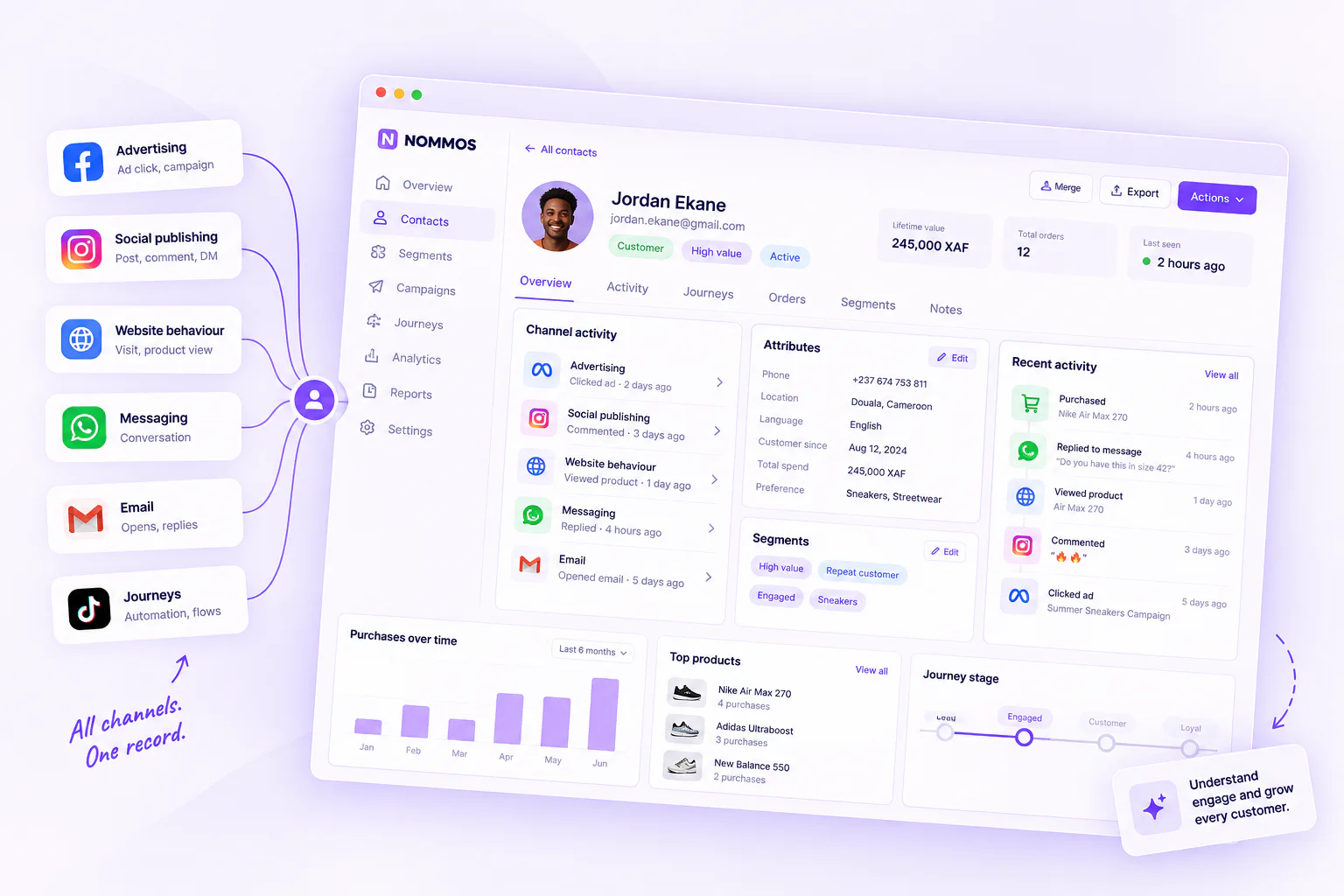
Once the record is whole, software can decide who to talk to, what to say, when and where — continuously, including at three in the morning on the day you are dealing with something else entirely. That is what the agents are: not writing assistants, but workers.
The obvious worry is control, and it is the right worry. Marketing is public and mistakes are visible. So control is part of the machinery rather than a reassurance: autonomy is a setting per agent, content can wait in a queue, a journey can be tested against a real customer without sending anything, and every action is recorded.
And where the product is uncertain — a creative score built on thin data, a heatmap from too few sessions, a platform that will not share its metrics — it says so, in the interface, rather than showing a confident number it cannot support.
Any number in the product should be able to explain where it came from. If it cannot, it is not finished.
Where a model is thin, a sample is small or a platform withholds data, the interface says so. A tool that admits its limits is easier to trust than one that never does.
Anything consequential can be previewed, simulated or approved first — and everything that happened is recorded.
The fastest way to judge a platform like this is to bring the control you are sure will be missing and check.