
Social Media
Compose once and publish across eight platforms with per-platform variants, a content calendar, an approval queue and post-level analytics.
Replaces your scheduler Social MediaSocial publishing, paid advertising, CRM journeys, customer messaging and website analytics — systems that normally do not talk to each other — built as one platform. What the ads learn, the CRM knows. What happens on your site changes who gets messaged next.
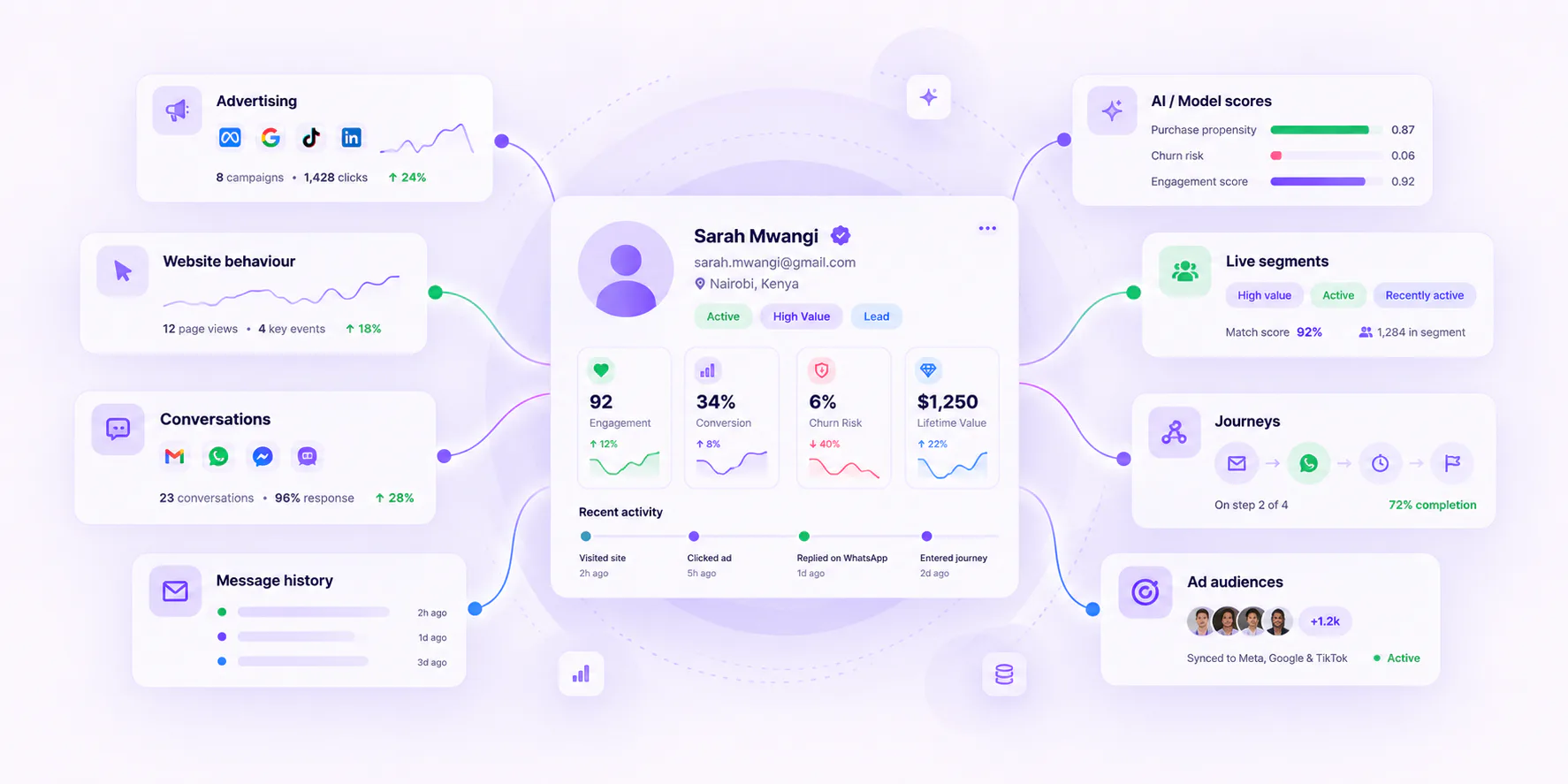
Each of these would normally be a separate purchase, a separate login and a separate customer list. Here they share one record, so automation can run across channels instead of stopping at the edge of one.
Compose once and publish across eight platforms with per-platform variants, a content calendar, an approval queue and post-level analytics.
Replaces your scheduler Social MediaFive ad networks with their real controls — placements, bid strategies, retargeting audiences, pixels and conversion events — plus one spend view across all of them.
Replaces five ad managers AdvertisingContacts, dynamic segments, lifecycle stages, journeys, broadcasts, templates and a shared inbox for every inbound conversation.
Replaces your email and automation tool CRMAround 40 kinds of meaningful action on your own site or app, conversion funnels, heatmaps, session replay and built-in consent management.
Replaces your analytics and heatmap tools Analytics & TrackingWhatsApp messaging, the website chatbot, heatmaps and session replay are part of the same platform, not add-ons with a customer list of their own.
Templates, approval and the 24-hour window
Explore WhatsApp marketingWebsite chat trained on your documents
Explore the website chatbotClicks, movement and scroll depth
Explore heatmapsWatch real visits, masked by default
Explore session replayA competitor can ship a feature. They cannot retrofit a single customer record underneath four products that were built separately. This is the structural difference, and everything else follows from it.
Seven specialists, each owning a slice of the operation, all reading from the same record — and each with its own autonomy setting. Whatever you hold back waits in an approval queue; whatever runs is recorded in the audit trail.
Posting times, refresh intervals and notification windows are configuration, not fixed behaviour.
A new workspace starts with every agent disabled. Enable them one at a time as you connect each channel.
An agent missing a connected account or a schedule shows Setup Required instead of failing quietly.
A live activity feed while they run, a daily brief of what changed, and an audit trail of every action.
Each brand has its own separated data, branding, currency, timezone and team. One login moves between them; nothing crosses over.
Permissions are set individually, so a freelancer, an analyst, a client and an administrator each get exactly what they need.
Every action is recorded — which matters more when some of those actions were taken by an agent rather than a person.
A consent platform is built into the tracking library, with categories, expiry, versioning and support for the browser's Global Privacy Control signal.
English, French and Spanish, switchable per user.
Each brand reports in its own currency. Where several are involved in one figure, the metric is split by platform rather than adding different currencies together.
A short walkthrough of the dashboard, the approval queue, a segment built on a model score, and a journey tested without sending anything.